
Rome in October: The Month the Clocks Change and the Queues Do Not
October is sold as Rome's perfect shoulder season. The official normals make it the second wettest month of the autumn, the arrivals index puts it near the top of the year, and after 25 October the Pantheon's last admission falls 48 minutes after dark.
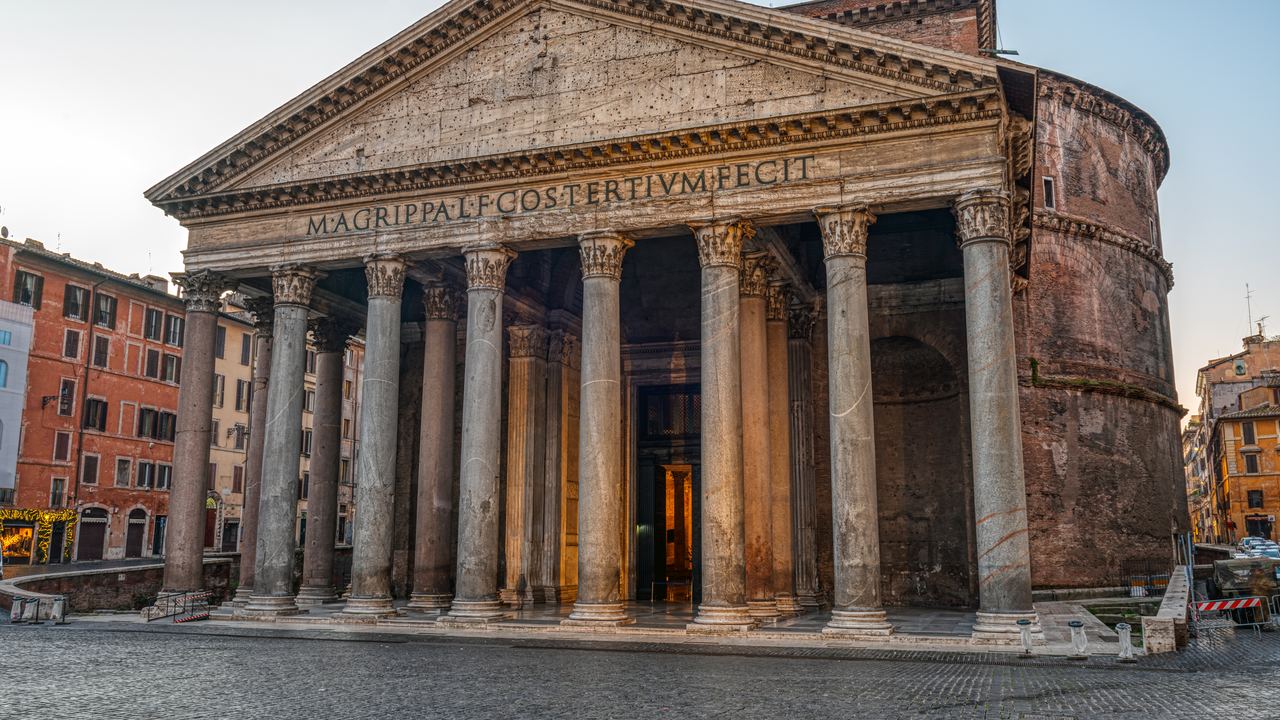
Rome in October loses an hour in a single night, and the monument at the centre of it keeps exactly the same hours it kept in August. On Saturday 24 October the last people admitted to the Pantheon go in at 18:30 with about a quarter of an hour of usable sky left. On Sunday the 25th the clocks go back, that same 18:30 slot opens 48 minutes after the sky has finished going dark, and nothing on the ticket says so.
That is the whole of October in one detail. The month gets sold as the perfect shoulder season, and on temperature it very nearly is. On rainfall, on daylight and on how full the room will be, it is not the month the brochures describe.
Rome in October: the numbers before the adjectives
Everything below comes from three places. The weather is the official Italian climate normals for 1991 to 2020, submitted for the station at Roma Ciampino, which is the only series for this city with a declared method and a declared period. The daylight is our own calculation for the co-ordinates of Piazza della Rotonda. The prices and hours are the Ministry of Culture's, read on 2 September this year. Where a figure does not exist, we have said so rather than borrowing one from somewhere adjacent.
The weather, from the station that actually publishes it
October in Rome averages 22.2 °C by day and 12.4 °C at night. That is shirt-sleeve weather at two in the afternoon and a jacket by seven. It is also the month the rain arrives: 91.8 mm across 7.7 days with measurable rain, against 67.6 mm in September. November is worse again at 112.8 mm, the wettest month of the Roman year on this series.
So the useful way to hold October is not wet or dry. It rains on roughly one day in four, and it rains hard when it does, because the totals climb faster than the rain days do. September and October are a day and a half apart in frequency and 24 mm apart in volume. Nothing about that is a drizzle.
| September | October | November | |
|---|---|---|---|
| Average daily high | 26.7 °C | 22.2 °C | 16.9 °C |
| Average daily low | 16.0 °C | 12.4 °C | 8.5 °C |
| Rainfall | 67.6 mm | 91.8 mm | 112.8 mm |
| Days with 1 mm or more | 6.3 | 7.7 | 9.3 |
| Sunshine per day | not in the submission | 6.3 h | 4.6 h |
Two honest caveats about that table, both of which matter more than they look.
The first is the empty cell. September's sunshine figure is blank because it is blank in the official submission, and the same is true of the summer rainfall for this station. We have left the gaps as gaps. Filling them from a coastal station, or from an older thirty-year period, would produce a table that looks complete and quietly mixes two different things.
The second is the station itself. Ciampino sits south-east of the city, outside it. Italy's environmental agency measures the urban station at Roma Macao at 17.8 °C mean annual temperature against Ciampino's 16.0, and 787 mm of annual rainfall against 623. The Pantheon stands in the warmer, wetter of the two. Read the table as the floor for temperature and the floor for rain, not the ceiling.
25 October, and the last admission that goes dark
Summer time across the European Union ends on the last Sunday in October, which this year is the 25th. The clocks go back an hour at three in the morning, local time. There has been talk of abolishing the practice since 2018 and no decision has followed, so it happens on schedule.
Here is what it does to a visit. The monument is open 9:00 to 19:00, with the ticket office closing at 18:00 and the last admission at 18:30. Those hours do not move with the season. The sky does.
| Date | Sunset | Sky fully dark | The 18:30 last admission |
|---|---|---|---|
| Thu 1 October | 18:52 | 19:19 | 50 minutes before dark |
| Sun 4 October | 18:46 | 19:14 | 45 minutes before dark |
| Thu 15 October | 18:28 | 18:56 | 27 minutes before dark |
| Sat 24 October | 18:15 | 18:43 | 14 minutes before dark |
| Sun 25 October | 17:13 | 17:42 | 48 minutes after dark |
| Sat 31 October | 17:05 | 17:34 | 55 minutes after dark |
Read the last column rather than the first. For most of October the final entry of the day still has light in it: on the 15th, 18:30 arrives 27 minutes before the sky finishes darkening. On the 24th the margin is down to about a quarter of an hour. On the 25th it inverts, and the last slot of the day sits three quarters of an hour into the night, where it stays until spring. The published opening hours and closures are the same in December as in July, which is the source of the confusion rather than the solution to it.
There is no artificial lighting inside. A late ticket in the last week of October buys you the shape of the room, the scale of it, and a circle of dark sky 43 metres up. That is not nothing, and some people prefer it. It is simply not what the photograph on the booking page shows, and the booking page does not distinguish between the two.

When it rains, and it does come in
The most common question about rain here has an answer the square will not give you: yes, it comes through the oculus and lands on the floor. The basilica that runs the liturgy inside it says so on its own website, and calls the opposite the most famous false legend about the place. There are drains under the marble to take it away, and they are ancient. We keep the longer list of things about the Pantheon that are not true on a page of its own.
What follows from that is practical rather than romantic. On a wet October afternoon the interior is not shelter, and neither is the square. Piazza della Rotonda has no arcade, no awnings and exactly one roof, which is the portico you are queueing under.

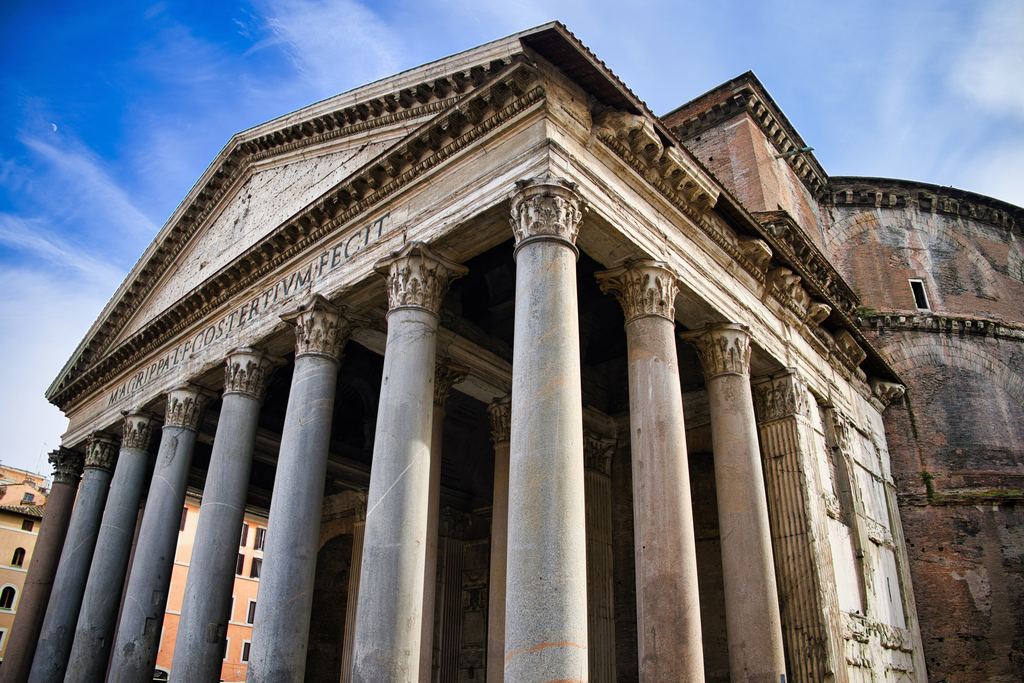
The only roof in the square
The portico is the shelter, and it is also the queue
When an October shower arrives, the sixteen granite columns of the portico are the only cover in Piazza della Rotonda, which is why the space under them fills with people who have no ticket and no intention of buying one.
There is no cloakroom inside and no left luggage, and the Ministry says so in as many words. A folded umbrella is fine. A wet one, a rucksack and a timed band are a poor combination in a room whose floor has been rained on since the second century.
Phone photographs are explicitly allowed. Phone calls are not.
Which queue you join matters more in the rain than in the sun. There are three at that door and they do not move at the same speed. The cash desk on the left clears in five to fifteen minutes even in high season; the card machines on the other side are the long one. We have written up all three queues separately, and in October the choice is the difference between a damp wait and a soaked one.
Four roofs within a few minutes of the portico
None of these is a wet-weather consolation prize. Three of them are things people plan whole afternoons around, and the fourth is where Romans go when it rains.
Three churches, no ticket
San Luigi dei Francesi is about three minutes from the portico and holds three Caravaggios. Sant'Ignazio and Santa Maria sopra Minerva are also free. Shoulders covered, and bring a coin: the paintings are often unlit until you feed the light box.
A palace with the collection still in it
Doria Pamphilj, Colonna, Altemps: rooms hung the way they were bought. The official ticket runs 16 to 17 euro and resellers list it at 32. Check the closing day before you walk over, because they are not all Monday.
Nine metres under the Trevi district
Vicus Caprarius, a Roman house and a stretch of aqueduct, 4 euro to walk in and 8 with a guide. Tuesday to Sunday, 11:00 to 17:00, closed Monday, and booking is by telephone or WhatsApp only.
The coffee bars, which are the real shelter
Tazza d'Oro is a minute from the portico and Sant'Eustachio two, and they make coffee differently from each other on purpose. Standing at the counter costs less than sitting down, here and everywhere else in Rome.
Is Rome in October low season? Not on either curve
No, and it is not close. Two separate curves exist for this, and neither puts October in the quiet half of the year.
On arrivals to the city, with 100 as the monthly average, October sits at 117. Only May, June and July are higher, and the margin over them is a rounding error. On the visitor curve for the museums of Lazio, October is 105. The foreign share of arrivals in October is 78%, the third highest of the year, which is the figure that decides what the room sounds like.
The two curves disagree elsewhere, and the disagreement is worth knowing if you are choosing between months. Lazio's museums peak in April at 137 and dip in July to 99; arrivals do close to the opposite. The gap is Italian schoolchildren, who fill museum slots in spring and are on holiday in July. Anyone reading in English should follow the arrivals curve, and remember that in April they are competing with school groups for the same timed bands.
Capacity is what turns an index into a queue. Entry runs in nine timed bands from 9:00 to 18:00, capped at 1,200 people to a band, a ceiling the Ministry publishes. The middle of the day fills first, in every month of the year.
| 1 | 2 | 3 | 4 | 5 | 6 | 7 | 8 | 9 | 10 | 11 | 12 |
Sunday 4 October, free and unbookable
The first Sunday of every month is free at the Pantheon, and in October that is the 4th. Two things about it are regularly got wrong by the people selling tickets around it.
The first is that it cannot be booked online. There is no timed band to reserve and no ticket to hold, so everybody joins one queue, and any product advertising guaranteed entry at a set hour on that date is selling something that does not exist that day. The second is the arithmetic: a free Sunday in a month running at 117 on the arrivals index is the fullest the building gets. If the point of the visit is the room rather than the €7 ticket, one of the other thirty days in October is a better purchase.
Two more ways in without paying, both of them year-round rather than October specials. Entry during Mass is free, for worship: 17:00 on Saturdays and the eves of feast days, 10:30 on Sundays and feast days. And residents of the comune of Rome go in free, under a measure with no end date but a review due around April 2029.
One thing that is not a way in: the Roma Pass and the Omnia card. The Ministry states plainly that the Pantheon belongs to neither circuit. Nobody selling you one mentions it.
Questions about Rome in October
Is October a good month to visit Rome?
For walking, yes: 22.2 °C by day is close to ideal and the light is long into the afternoon for the first three weeks. For quiet, no. October runs at 117 on the arrivals index against a yearly average of 100, which makes it one of the four busiest months of the year. And it is the second wettest month of the Roman autumn, at 91.8 mm. Come for the weather, not for the space.
How much rain falls in Rome in October?
91.8 mm across 7.7 days with 1 mm or more, on the WMO normals for 1991 to 2020 at Roma Ciampino. That is roughly one wet day in four. The city centre is wetter than that station: the urban gauge at Roma Macao records 787 mm a year against Ciampino's 623, so treat the figure as a floor.
When do the clocks change in Rome in October 2026?
On Sunday 25 October, at three in the morning local time, when they go back an hour. Sunset moves from 18:15 on the 24th to 17:13 on the 25th. Nothing changes in the sky; the sun sets about two minutes earlier than the day before. The hour is a clock decision, and the EU has not yet ended the practice despite proposing it in 2018.
Is the Pantheon open in October, and what does it cost?
Open every day, 9:00 to 19:00, the same as the rest of the year. The ticket office closes at 18:00 and the last admission is 18:30, or 18:00 for groups and schools. Admission is €7, €2 for EU citizens aged 18 to 25, and free under 18. The price rose from €5 on 1 July 2026.
Is the Pantheon free on the first Sunday of October?
Yes, on Sunday 4 October, and it cannot be reserved. Free Sundays have no online booking and no timed entry, so there is a single queue for everybody. It is also the busiest day of the month by some distance. If a seller is offering you a guaranteed entry time on that date, the thing being sold does not exist that day.
Does the Roma Pass cover the Pantheon?
No. Neither the Roma Pass nor the Omnia card includes it, and the Ministry of Culture says so on the monument's own page. It is one of the few statements on that page that almost no site reselling Rome city passes repeats.
The month-by-month version, without the sales pitch
Which weeks are worth the trip, which hours inside the building are worth the timed band, and where the two disagree.
If the afternoon is a write-off
Collections in the rooms they were bought for, a few minutes from the portico and under a roof. Opening days vary more than you would expect, which is most of what a guided slot is buying you in October.
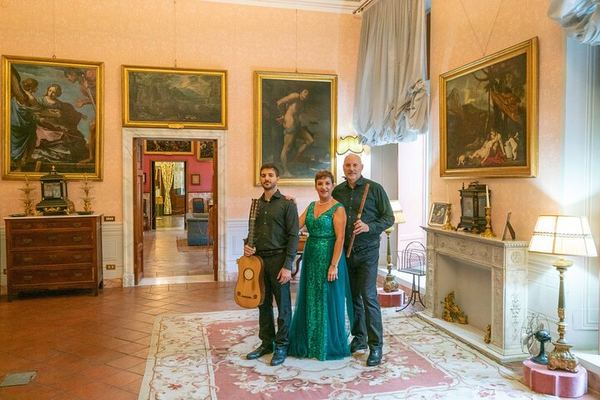
Baroque Instruments in the Princess's Apartment, for Twenty-Five
Theorbo, traverso and soprano, playing music written for these forces in a room this size. Doors close at 7:15 and nobody is let in after.
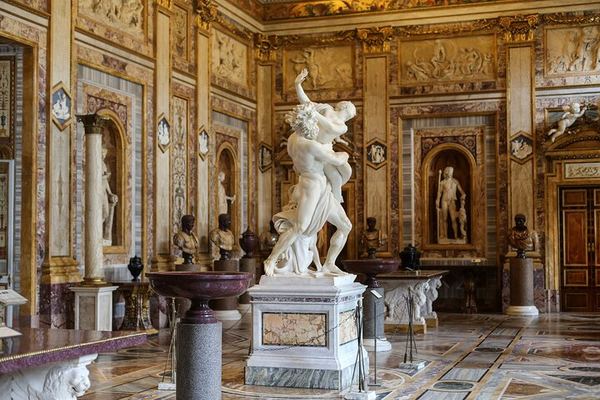
Borghese Gallery and Gardens, Ending on the Pincio
Leaves you at the terrace above Piazza del Popolo rather than back at the villa, with headsets throughout. The exit involves a long staircase.
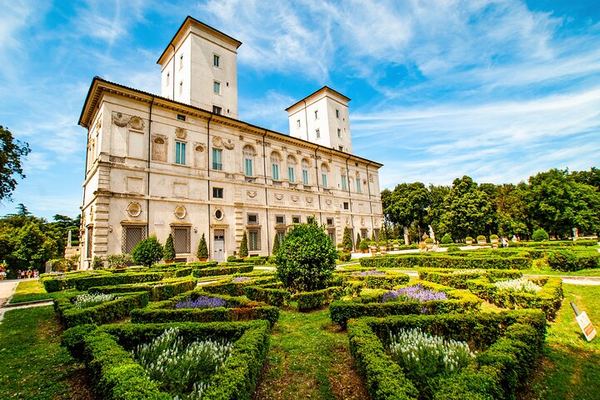
Borghese Gallery, and What to Do in the Park Afterwards
Names the route out: the rowing-boat lake, the Pincio terrace, the Casina Valadier and the smallest cinema in the world. Six, fifteen or ticket only.
Ratings collected by Viator and Tripadvisor
Data verified on. Climate: WMO normals 1991-2020, Roma Ciampino. Hours and prices: Ministry of Culture, read 2 September 2026. Sunset and twilight computed for Piazza della Rotonda.


